How to Repair Rust on a Truck
How to repair rust on a truck depends on the severity of the corrosion: surface rust needs sanding, a rust converter, and primer, while rust holes and frame corrosion require welding or patch panels. This guide from
New England Rust Defenders in East Bridgewater, MA, covers assessment, surface repair, scale removal, welding, and prevention.
Key Takeaways
- Truck rust repair starts with a structural safety assessment, and New England Rust Defenders uses a hammer-tap test before any cosmetic sanding.
- 80- to 120-grit sandpaper removes surface rust to bare metal on small spots, and then a rust converter helps neutralize remaining microscopic corrosion.
- Rust holes in rocker panels, cab corners, and bed sides usually need welding or patch panels, not body filler.
- NH Oil undercoating is an oil-based coating reapplied annually, while Boss Wax & Oil is a long-term protective coating designed for new trucks.
- DIY surface-rust materials typically cost $50 to $400; severe frame or panel repair with welding can exceed $7,000.
How Severe Is the Truck Rust?
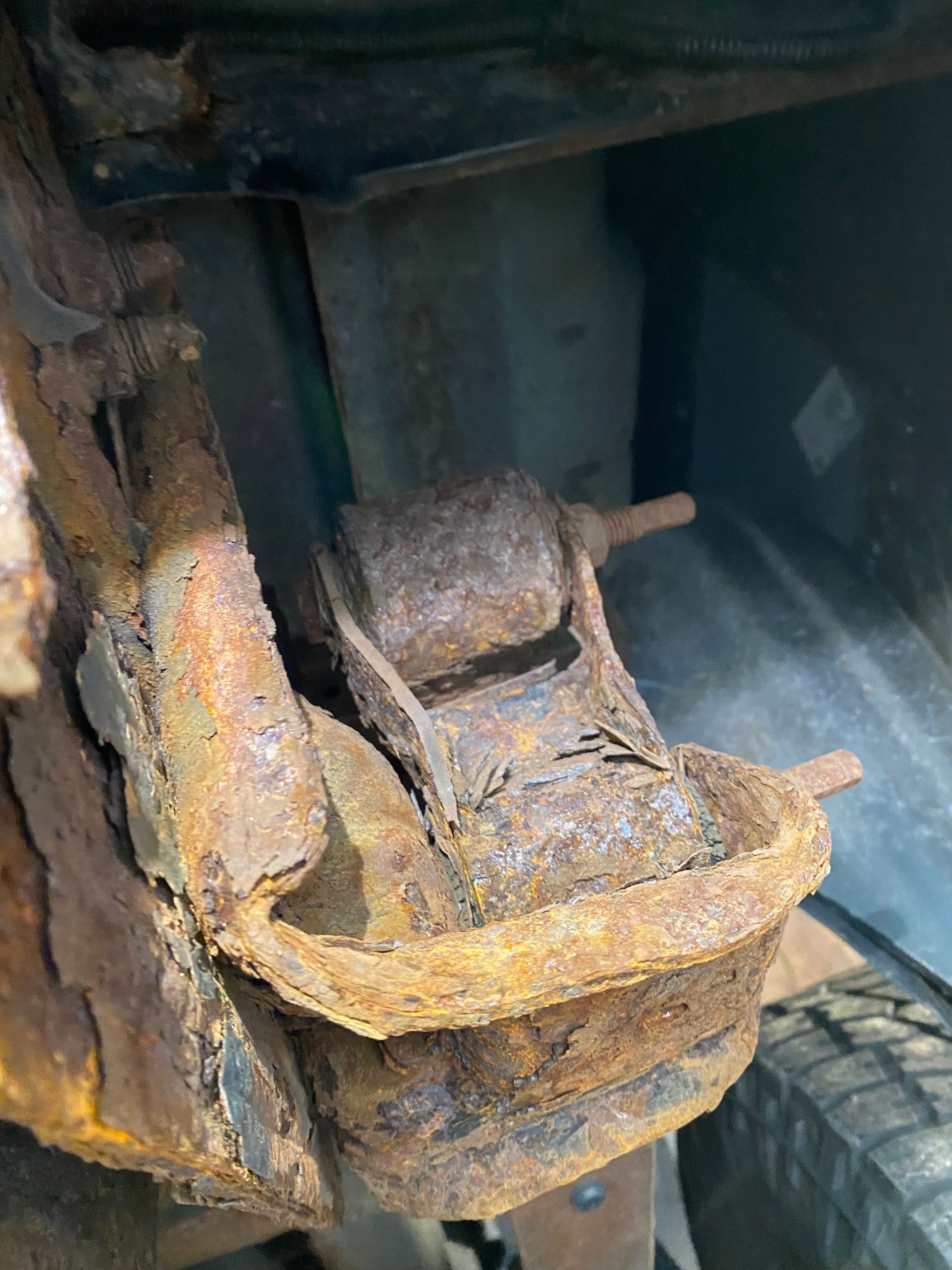
Rust severity falls into four tiers (surface rust, scale, holes, and structural rust), and the tier determines the appropriate repair. A hammer tap on the frame rails, rocker panels, and cab corners reveals thin metal and soft spots that sanding cannot save. Road salt and winter driving accelerate oxidation on truck undercarriages, so trucks from cold climates tend to show more serious damage.
The four levels can be summarized as follows:
- Surface rust: Light discoloration that has not significantly penetrated the steel.
- Scale: Flaky buildup that lifts off in layers.
- Rust holes: Areas where corrosion has broken through the metal completely.
- Structural rust: Corrosion that weakens frame rails, rocker panels, cab corners, wheel wells, or bed sides and may affect load-bearing strength or protection of critical components.
Expert Insight:
"A hammer tap on the frame or a cab corner tells the technician whether a truck is a sanding job or a welding job, before a single dollar goes into cosmetics." - New England Rust Defenders team (a Service-Disabled Veteran-Owned Certified shop)
How Surface Rust Repair Works
Surface rust repair begins with degreasing, then stripping the spot to bare metal so primer can bond. Abrasive tools such as 80- to 120-grit sandpaper or a wire wheel must reach clean steel, and a respirator, eye protection, and gloves help protect against rust dust.
Rust converter handles the microscopic traces that remain after sanding; many converters use phosphoric or tannic acid to neutralize corrosion and leave a stable surface. The rust-inhibiting primer then seals the bare metal and provides a base for paint. The repair finishes with color-matched paint and a protective clear coat that restores factory gloss. DIY surface rust materials for small spots typically run $50 to $400.
| Surface Rust Step | Tool or Product | Purpose |
|---|---|---|
| Clean | Degreaser | Removes oils, road salt, and grime |
| Strip | 80- to 120-grit sandpaper or wire wheel | Reaches bare metal |
| Treat | Rust converter | Helps neutralize remaining corrosion |
| Seal | Rust-inhibiting primer | Creates a moisture barrier |
| Finish | Paint and clear coat | Restores appearance and protection |
How Scale Is Removed and Bare Metal Prepared
Loose scale must come off before any converter, primer, or coating goes on, because chemical products may not effectively penetrate thick oxidation. Needle scalers and wire brushes strip heavy scale far faster than sandpaper, exposing the healthy steel underneath rather than sealing over flaky corrosion.
Bare-metal preparation plays a major role in how long the repair lasts. A degreaser lifts road salt, oil, and grime, and a clean, dry surface gives converter and primer a stronger bond. Scale usually develops after years of winter use, collecting in frame rails, brackets, crossmembers, and inner-fender areas where moisture and debris sit undisturbed.
For heavy scale, the basic preparation sequence is:
- Remove loose scale with a needle scaler or wire brush.
- Degrease the surface to remove oil, road salt, and grime.
- Dry and inspect the metal before applying any converter or coating.
- Treat and seal the stable surface once loose corrosion has been removed.
When Rust Holes Need Welding or Patch Panels
Rust holes generally require welded steel or an appropriately fitted patch panel for a durable repair. Body filler smooths small non-structural pits but never restores strength. A patch panel replaces rotted metal in rocker panels, cab corners, and bed sides: the damaged section is cut out completely, and welding ties the new panel into healthy surrounding steel.
Professional shops reach for welding whenever a hole passes through the panel or touches a structural area. Mesh patches help only on minor, non-load-bearing holes, and filler over a mesh patch counts as a short-term cosmetic finish, not a structural repair.
| Repair Method | Best Use | Durability |
|---|---|---|
| Body filler | Small non-structural pits | Temporary |
| Mesh patch with filler | Minor holes off critical structure | Limited |
| Patch panel | Rocker panels, cab corners, bed sides | Long-term |
| Welded new steel | Rust holes and structural areas | Durable |
How Truck Frame Rust Is Repaired Safely
Truck frame rust repair starts with removing heavy scale, then evaluating the remaining metal before fabrication or welding is considered. Needle scalers and wire brushes strip flaky rust from frame rails, crossmembers, and brackets, and a moisture-cured urethane rust encapsulator then seals the stable metal from oxygen and moisture once it is degreased.
Severe frame rust, meaning thin, cracked, or perforated sections, belongs in a professional body shop, where fabrication and welding can help restore load-bearing strength. Internal frame cavities matter as much as the visible rail surface, because moisture hides inside boxed sections. This is where New England Rust Defenders leans on cavity coverage and annual undercoating, and on Rustoration® for trucks that have already rusted through, a signature process combining rust removal, protective coatings, and metal preservation. Weighing the
pros and cons of vehicle undercoating helps owners match the right coating to a truck's age and rust level before that final barrier goes on.
| Condition | Best Approach | Typical Outcome |
|---|---|---|
| Light surface rust | Degreaser and rust converter | Coatable surface |
| Heavy scale | Needle scaler and wire brush | Stable base for coating |
| Tightly adhered rust | Moisture-cured rust encapsulator | Sealed metal barrier |
| Structural perforation | Fabrication and welding | Restored structural strength |
Which Products Stop Rust From Returning
Preventing rust from returning requires the right combination of coating, cavity protection, and undercoating. Rust-inhibiting primer and clear coat finish the visible repair, while cavity wax reaches enclosed box sections through 360-degree nozzles where brushes cannot fit.
New England Rust Defenders applies NH Oil undercoating to penetrate seams and crevices, help displace moisture, and slow or stop active corrosion in the metal. It also protects vinyl and plastic surfaces, lubricates moving parts, takes roughly an hour per vehicle, is applied once a year, and suits trucks with any amount of existing rust.
Boss Wax & Oil is a different option built for the clean, rust-free undercarriage of a new truck, where the fast-curing, heavy-duty inhibitor forms a long-term protective barrier backed by a transferable warranty. The right undercoating depends on whether the truck already has corrosion or is being protected before rust develops, and different undercoating options suit different conditions. Trucks in winter states gain the most from annual truck undercoating in East Bridgewater.
The main products and protection methods include:
- NH Oil: Annual undercoating for trucks with existing or developing rust. It helps protect seams, crevices, and exposed metal from moisture and road salt.
- Boss Wax & Oil: Long-term protection for clean, rust-free undercarriages, particularly on new trucks.
- Cavity wax: Helps protect enclosed box sections where moisture and debris can collect.
- Rust-inhibiting primer: Seals bare metal after rust removal and provides a base for paint.
- Paint and clear coat: Help protect repaired exterior metal while restoring its appearance.
A repaired panel lasts longest when the inside stays sealed, so cavity protection is just as important as protecting the visible exterior metal.
What to Do Next
Send New England Rust Defenders 2-3 photos of your current vehicle, including the undercarriage, wheel wells, and any bubbling paint, to get a repair-versus-replace assessment and a detailed quote that separates a quick sanding job from welding and patch-panel work. Car Rust Repair Service in East Bridgewater, MA, covers everything from surface sanding to full Rustoration® on vehicles that have already rusted through.
Frequently Asked Questions
About New England Rust Defenders
The New England Rust Defenders Team is a Service-Disabled Veteran-Owned Certified vehicle-protection shop in East Bridgewater, MA. The team specializes in car rust repair, frame assessment, patch-panel work, and annual undercoating with NH Oil and Boss Wax & Oil.
Last updated: August 2026
You might also like